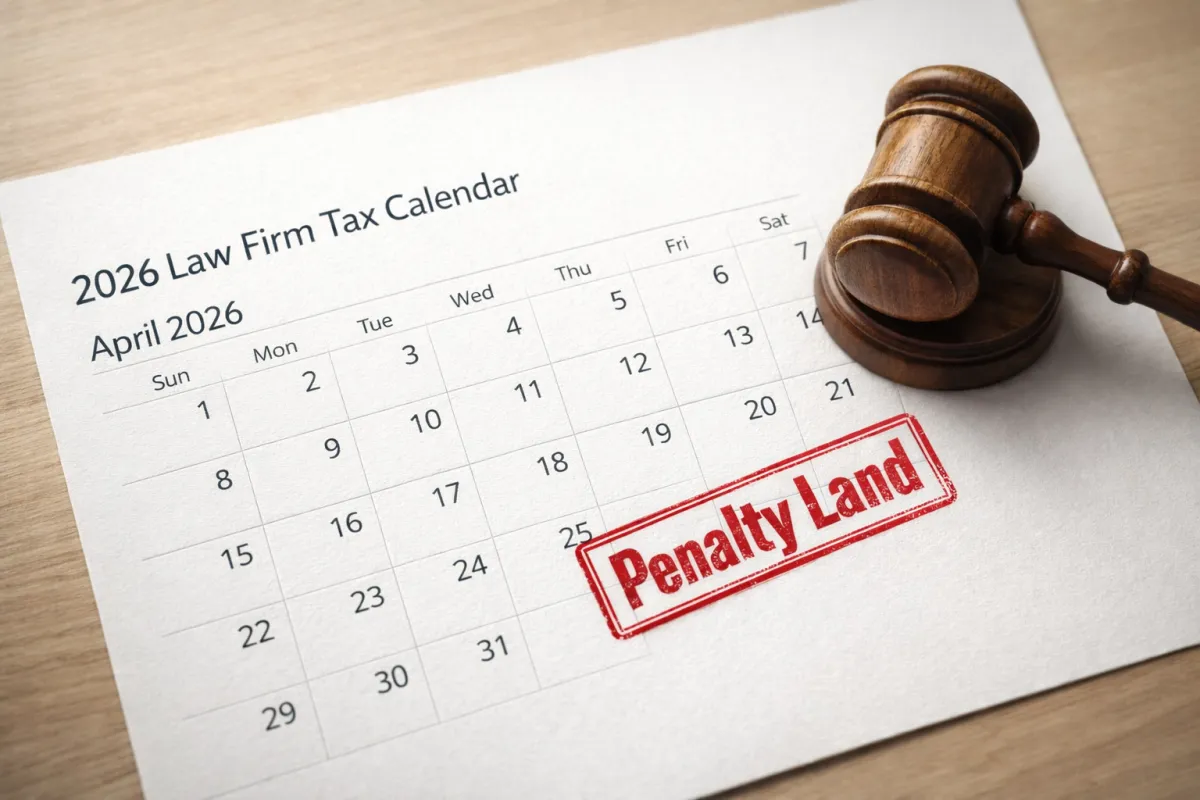
2026 Tax Deadlines Law Firm Owners Can’t Miss
The Calendar That Keeps You Out of Penalty Land📅⚖️
If you run a law firm, the IRS doesn’t care that you were in trial, stuck in mediation, or buried under client emergencies.
Deadlines are binary: you either hit them or you don’t.
And in 2026, missing the wrong date doesn’t just mean a slap on the wrist, it can mean stacked penalties, interest, and a lot of avoidable conversations with your partners about “why this wasn’t on our calendar.”
This post gives you a law-firm-specific 2026 tax calendar so you can:
Avoid late-filing and late-payment penalties 💸
Keep K-1s, W-2s, and 1099s out of chaos territory
Tie tax dates into cash flow and operations, not just your CPA’s to-do list
Below, assume a U.S. calendar-year law firm (most common). State deadlines can differ, so think of this as your federal backbone you’ll layer state rules onto.

The Big Picture: How to Think About 2026 Tax Deadlines
There are really five “tracks” your 2026 calendar needs to manage:
Business income tax returns – your partnership, S corp, or C corp filing
Owner personal returns – your 1040, which often can’t be finished until business returns are done
Quarterly estimated tax payments – for both the firm and the owners, if withholding doesn’t fully cover the bill
Information returns – W-2s, 1099-NEC/1099-MISC, etc.
Payroll tax filings – Form 941 and related deposits
When firms get in trouble, it’s rarely because they didn’t “know” April 15 exists. It’s because:
K-1s weren’t ready on time
1099s or W-2s were an afterthought
Estimated taxes weren’t integrated into cash flow
So we’ll structure this as a practical law firm tax calendar for 2026, plus what it means operationally for a law firm owner.

January 2026: Information Returns and Year-End Cleanup 🧾
Key Deadlines:
Monday, February 2, 2026 (the deadline shifts because January 31, 2026 falls on a Saturday)
Forms W-2 to employees and filed with SSA
Forms 1099-NEC (nonemployee compensation) to recipients and filed with the IRS
These dates are hard-edged. Late or incorrect forms can trigger penalties per form, which adds up quickly if you have multiple staff and contractors.
Law Firm Action Checklist (January)
Make sure payroll is fully reconciled for 2025 before W-2s go out. If your books and payroll system don’t match, fix that now, not during an audit.
Confirm your 1099-NEC list: contract attorneys, investigators, experts, freelance paralegals, marketing contractors, etc.
Don’t wait for your CPA alone: have someone on your team own the W-9/1099 process so you’re not chasing tax IDs in mid-January.
Penalty Land Risk: Sloppy or late W-2/1099 filings are low-glamour but high-penalty. This is often the first place small firms trip.

March 2026: The Partnership and S Corp Bottleneck
If your firm is taxed as a partnership (Form 1065) or S corporation (Form 1120-S), this is your first major cliff.
Key Deadline:
March 16, 2026 – Partnership and S corporation returns due (for calendar-year firms), because March 15 falls on a Sunday.
Form 1065 (partnerships/LLCs taxed as partnerships)
Form 1120-S (S corporations)
Schedule K-1s to partners/shareholders should be ready by this date
Extension Option:
File Form 7004 by March 16, 2026 to extend the partnership or S corp return to September 15, 2026.
Remember: the extension does not extend the time to pay tax (where applicable). For partnerships, the real pain tends to show up at the partner level when K-1s are late.
Why This Matters for Law Firms
Most multi-owner firms and many “solo but growing” practices use an S corp or partnership structure.
If this deadline slips, every owner’s personal 1040 is pushed into extension territory, even if they wanted to file on time.
Law Firm Action Checklist (January–March)
Close your 2025 books by mid-February at the latest.
Waiting until March to reconcile is how you end up in a permanent extension cycle.
Require partners to submit all reimbursable expenses monthly in 2025, not as a year-end dump.
Have a standing meeting with your tax advisor in early February: “Are we on track for a March 16 filing, or are we planning an extension with estimates?”
Penalty Land Risk: The bigger risk is a domino effect: late K-1s → late 1040s → messy estimated taxes for 2026.

April 15, 2026: The 1040 and C Corp “National Deadline” 🇺🇸
Key Deadlines
Individual returns – Form 1040 (2025 tax year) due April 15, 2026
C corporation returns – Form 1120 (calendar year) also due April 15, 2026
First 2026 estimated tax payment due April 15, 2026 (for individuals and many calendar-year taxpayers who pay estimates)
Emancipation Day in D.C. is April 16, 2026, but it does not move the April 15 deadline for 2026 (IRS still lists April 15, 2026 as the filing date).
Extension Options
Individuals: file Form 4868 by April 15, 2026 to extend your 1040 to October 15, 2026
C corps: file Form 7004 by April 15, 2026 to extend to October 15, 2026
Again, an extension only extends the time to file, not the time to pay. Underpaying in April still racks up interest and potential penalties.
Law Firm Action Checklist (February–April)
If your firm is a partnership or S corp, confirm March 16 status early: are K-1s done? If not, assume you’re on an extension path and plan your owner cash accordingly.
For owner 1040s, work with your advisor to run a 2025 tax projection by early March, especially if you had:
A breakout year
Lumpy contingency fees
Big capital expenditures or retirement contributions
Decide before April 1 whether you’re filing or extending, so you’re not panicking at the last second.
Penalty Land Risk: Many law firm owners think, “I filed an extension, I’m fine,” and underpay massively in April. The IRS cares about when you paid, not just when you filed.
Quarterly Estimated Taxes in 2026: The Real Penalty Trap 🪤
If your firm is profitable and you’re not paying enough through payroll withholding, you’ll likely owe estimated taxes.
For 2026, the standard individual estimated tax due dates are:
April 15, 2026 – 1st quarter payment
June 15, 2026 – 2nd quarter payment
September 15, 2026 – 3rd quarter payment
January 15, 2027 – 4th quarter payment for 2026
Law Firm Action Checklist (All Year)
Build a tax reserve system: every time cash hits your operating account, move a set percentage (often 25–35%+ for federal, plus state as needed) into a separate tax reserve account.
Schedule quarterly check-ins with your tax pro to update projections based on year-to-date revenue, not last year’s numbers.
If you’re on payroll as an S corp owner, you can often adjust W-2 withholding to cover some or all of your estimated tax needs instead of writing big quarterly checks — but that needs to be planned.
Penalty Land Risk: Underpayment penalties usually feel “invisible” until the return is filed. They’re death by a thousand cuts, especially for firms with lumpy income.
September and October 2026: Extension Season and Cleanup ⏳
If you extended your business or personal returns, these are your last-chance deadlines.
Key Deadlines:
September 15, 2026 – Extended Form 1065 (partnerships) and Form 1120-S (S corps) due
October 15, 2026 – Extended Form 1040 (individual) and extended Form 1120 (C corps) due
By the time you hit these dates, the work should be mostly done.
If you’re still scrambling in early September or early October, it’s a sign that your monthly/quarterly close process is broken, not just your “tax prep timing.”
Law Firm Action Checklist (Summer–Fall)
Treat June 30 as your internal “soft deadline” for having books cleaned through May and major reconciling items identified.
Use August to fix outstanding issues: missing W-9s, uncategorized expenses, trust/IOLTA reconciliation problems, etc.
By Labor Day, your tax pro should have nearly everything they need to hit a clean, on-time extended filing.
Penalty Land Risk: Extensions are fine when planned; they’re dangerous when they’re really just evidence that no one is closing the books until the last minute.

Payroll and 941 Filings: The Quiet Compliance Calendar in the Background 🧾🔒
If you run payroll, and most firms with staff or S corp owners do, you also have quarterly filing obligations.
Form 941 is generally due April 30, July 31, Oct. 31, and Jan. 31 (the last day of the month after the quarter ends).
If a due date falls on a weekend or legal holiday, it rolls to the next business day (important in 2026).
2026 Practical Due Dates (with weekend adjustments):
April 30, 2026 – 1st quarter (Jan–Mar)
July 31, 2026 – 2nd quarter (Apr–Jun)
Monday, November 2, 2026 – 3rd quarter (Jul–Sep) because Oct 31, 2026 is a Saturday
Monday, February 1, 2027 – 4th quarter (Oct–Dec) because Jan 31, 2027 is a Sunday
Deposit schedules (semiweekly vs monthly) depend on your total payroll tax liability; your payroll provider should tell you which rules apply, but you are still legally responsible.
Law Firm Action Checklist (Quarterly):
After each quarter closes, confirm:
Payroll reports match what hit your bank
Amounts on Form 941 match your books
Any owner bonuses or adjustments were handled consistently
Don’t treat payroll as “set and forget.” Make sure someone reconciles payroll every month as part of your close
Penalty Land Risk: Payroll penalties are some of the nastiest: late deposits, missed forms, and trust-fund recovery exposure if things really go sideways.

Putting It All Together: Your 2026 Law Firm Tax Calendar (At a Glance) 🗓️
Here’s a simplified federal calendar for a calendar-year U.S. law firm:
February 2, 2026
W-2s to employees and SSA; 1099-NEC to contractors and IRS (weekend shift from Jan 31)
March 16, 2026
Form 1065 and Form 1120-S due; K-1s out to partners/shareholders
File Form 7004 to extend to September 15
April 15, 2026
Form 1040 and Form 1120 due
First 2026 estimated tax payment due
File Form 4868 (individual) or Form 7004 (C corp) to extend (pay still due)
April 30, 2026
Form 941 for Q1 payroll due
June 15, 2026
Second 2026 estimated tax payment due
July 31, 2026
Form 941 for Q2 payroll due
September 15, 2026
Extended partnership and S corp returns due (Forms 1065 and 1120-S)
Third 2026 estimated tax payment due
October 15, 2026
Extended individual and C corp returns due (Form 1040 and Form 1120)
November 2, 2026
Form 941 for Q3 payroll due (weekend shift from Oct 31)
January 15, 2027
Fourth 2026 estimated tax payment due
February 1, 2027
Form 941 for Q4 payroll due (weekend shift from Jan 31)
W-2s and 1099-NEC for 2026 are also effectively due around this same window when Jan 31 falls on a weekend (plan for early completion).
Use this as your master template, then layer in:
State income tax deadlines
State estimated taxes
Local business taxes or gross receipts taxes (common in big metro areas)

How to Keep Your Firm Out of “Penalty Land” in Practice ✅
Knowing the dates is only half the game.
The other half is operationalizing them so you don’t depend on memory or last-minute heroics.
Here’s a simple operating system that works well for law firms:
One shared calendar
Create a dedicated “Tax & Compliance” calendar for the firm
Put every deadline above on that calendar with reminders at 30, 14, and 7 days
Monthly close checklist
Bank and credit card reconciliations
Trust/IOLTA reconciliations
Payroll tie-out (does payroll match your accounting and cash?)
W-9 and vendor file review
Quarterly tax review rhythm
Schedule four standing meetings per year with your tax/CFO team (around each estimated tax deadline)
Review year-to-date profit, projected 1040 results for owners, and whether estimates or withholding need to change
Owner compensation policy
For S corp owners and partners, define how much cash can leave the firm as salary/draws without starving tax reserves
Tie that policy to your tax reserve account so no one is guessing
Decide on extensions early
There’s nothing wrong with filing on extension if it’s planned. The problem is deciding on April 13.
By February for entities and March for owners, decide: “On-time filing vs extension + payment?”
When you run this as a system, deadlines stop being anxiety triggers and start being just another part of your firm’s operating calendar.